Maslow Has Some Explaining To Do
You're going to want to sit down for this tea 🫖
One of the most famous frameworks in leadership history has some serious drama behind it.
You know the Maslow's Hierarchy? The one that has food and water at the bottom, self-actualization at the top, because apparently you can't want meaning and purpose in your work until you've sorted out literally every other need you've ever had. 🙄
It's been in every leadership course and MBA program since the 1940s…
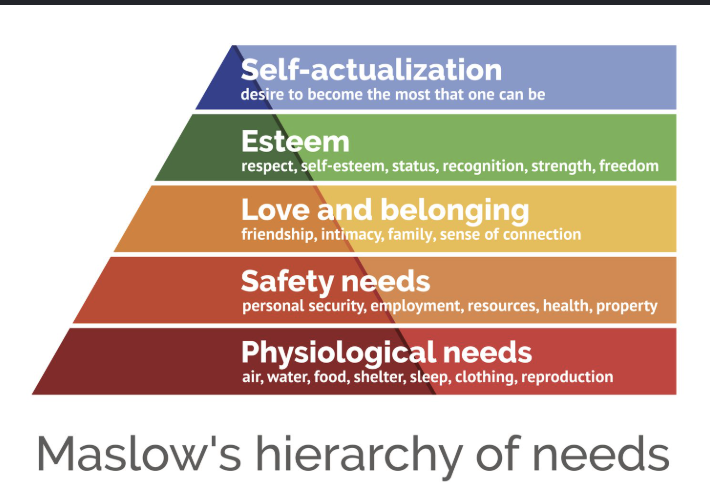
👈🏼 Remember this?
But it has some maaaaaaajor issues.
Starting with, as women who lead people for a living, we know better than anyone that human beings are not that simple.
So, how did we get here?
Before Maslow ever published his famous theory, he spent six weeks living with the Siksika (Blackfoot) Nation in Alberta, Canada. He was genuinely stuck on his research and what he experienced there changed everything for him. Scholars and Blackfoot researchers have since documented that his work drew heavily from what he observed in that community and he never credited them for it 😬
And here's where it gets really interesting. The Blackfoot understanding of human thriving looks nothing like his pyramid. In their worldview, self-actualization isn't something you earn at the top. It's the starting point, not the finish line.
And the thing Maslow left out entirely? Community. The idea that above the individual comes collective flourishing, and that your purpose is ultimately tied to something bigger than yourself.
When that got filtered through a Western academic lens, the community part just... *POOF*. Disappeared.
Also worth knowing: despite being taught everywhere for 80 years, Maslow's hierarchy has pretty limited scientific support. So we've been building entire people strategies on a framework that was never fully validated and only told part of the story to begin with.
Why You Should Care
Here's what I keep coming back to as a woman and a leadership coach. The things that actually motivate me? That motivate my clients? They've never fit cleanly on that pyramid and in that order.
It's not just about salary or a title bump. It's about whether her values show up in how she work. It's the relationships on her team that make hard days bearable. It's the feeling that what she's doing actually means something to real people. I know you know what I'm talking about.
And the women I see leading really well aren't the ones who have mastered the checklist. They're the ones who see their people fully. Who ask better questions. Who understand that someone being "disengaged" might have nothing to do with their job description and everything to do with whether they feel like they actually belong there.
So when you think about what your team needs try dropping the pyramid for a minute. Ask yourself if you're actually seeing them as full humans or just tracking where they land on a five-step model that a guy built in the 1940s after six weeks with a community he never even cited.
xoxo
Kelsey
This Week's Thing
Think about someone on your team who's seemed off lately (or maybe you even need to think about yourself!).
Before you diagnose it or make it a performance conversation, just ask them how they're doing. Not as a formality, actually ask. Tell them you've been thinking about what makes people feel genuinely supported at work and you want to make sure they feel supported, motivated, and fulfilled at work.
Then just listen. Notice what comes up. Notice whether it fits neatly on a pyramid or whether it's more complicated and human than that. It probably will be.
If it's you who has been feeling off and unmotivated lately, take a few minutes to reflect on how you're doing and if you feel supported at work. What do you need to feel fulfilled and supported?
And then actually do something with what you heard or called out. Maybe that's a schedule change, a different kind of project, more autonomy, a conversation about where they or you want to go. Whatever it is, let them know you heard them and that you're thinking about it. You don't have to fix everything in one conversation but the fact that you came back with something real is what makes the difference between a leader who asks good questions and a leader who actually changes things.